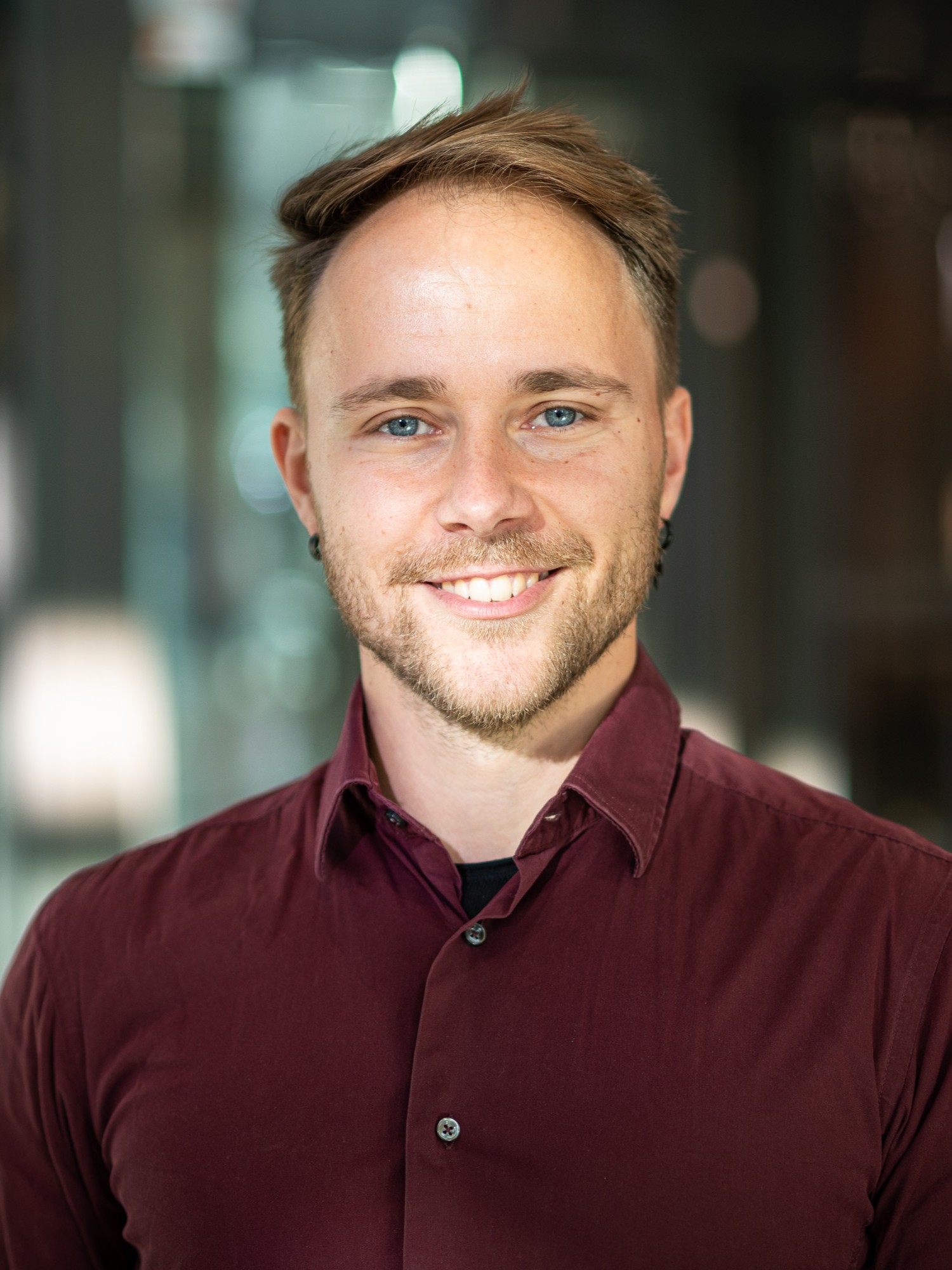
Jimmy Köpke
Contact/ Address
PhD candidate
Jimmy Köpke
Phone: +49 (0) 341 6025-1759
Office: Building 1.0, Room 023
Curriculum Vitae
| Jan 2026 - June 2026 | Visiting PhD student at Institute for Urban Environment, Chinese Academy of Sciences (CAS), Xiamen (China) |
| May 2022 - Present | PhD candidate at UFZ and German Environment Agency (UBA) (Department of Water treatment) |
| May 2022 - Nov 2022 | Research Assistant (Intern) at the United Nations University - Institute for Water Environment and Health (UNU-INWEH), Ontario (Canada), Topic: Global Bottled Water Industry - A Review on Impacts and Trends |
| Sep 2021 - Jan 2022 | FPI Research Fellow; Universidade de Santiago de Compostela, CRETUS (Spain), Topic: Assessment of antibiotic biotransformation and antibiotic resistance abatement in High-rate activated sludge systems (HRAS) |
| 2017 - 2021 | M.Sc. in Environmental Sciences and Engineering at Technische Universität (TU) Berlin; Focus: Environmental Biotechnology |
| 2019 - 2020 | Exchange semester at Tsinghua University (Beijing, China), Graduate programme in Environmental Science and Technology |
| 2019 | SCELSE Summer school; Singaporian Centre for Environmental Research (SCELSE; Singapore) |
| 2013 - 2018 | B.Sc. in Environmental Science and Engineering, TU Berlin; Focus: Environmental Microbiology |
Research
My research explores the fate and transformation of organic micropollutants (OMPs) in aquatic environments and water treatment systems. At the interface of environmental biotechnology, microbial ecology, and analytical chemistry, I investigate how microbial activity, redox conditions, and organic matter govern contaminant transformation. My PhD focuses on bank filtration and managed aquifer recharge as natural treatment barriers for protecting groundwater and drinking water resources.
I combine long-term laboratory column experiments, pure-culture studies, and environmental sampling to understand where, how, and under which conditions micropollutants are transformed. A central question is how the spatial sequence of oxic and anoxic environments shapes microbial communities, transformation pathways, and the subsequent fate of transformation products. This work extends beyond parent-compound removal to examine the formation, persistence, and further transformation of products.
My methodological approach integrates liquid chromatography–tandem and high-resolution mass spectrometry for contaminant quantification and transformation product identification with microbial community analysis and comparative proteomics and metaproteomics. Through collaborative research, we also combine transformation product analysis with multielement compound-specific stable isotope analysis to elucidate photochemical and advanced oxidation mechanisms. Related projects extend these questions to graywater treatment in wetland roofs and antibiotic transformation during nutrient recovery from wastewater.
Overall, my research seeks to connect molecular transformation mechanisms with microbial processes and treatment-system design. The goal is to identify conditions that support effective contaminant attenuation while accounting for transformation product persistence, thereby promoting sustainable water treatment, reuse, and drinking water resource protection.
Publications
Index:
You could use our publication index for further requests.
2026 (2)
- Köpke, J., Adrian, L. (2026):
Proteomic data of Nitratidesulfovibrio vulgaris Hildenborough
PRoteomics IDEntifications Database (PRIDE)
10.6019/PXD068774 - Köpke, J., Ouyang, W.-Y., Akay, C., Ding, C., Ruhl, A.S., Adrian, L. (2026):
Physiological characterization of anaerobic cometabolic transformation of sulfamethoxazole by Nitratidesulfovibrio vulgaris Hildenborough
Appl. Microbiol. Biotechnol. 110 , art. 129
10.1007/s00253-026-13792-3
2025 (2)
- Köpke, J., Bayarsaikhan, U., Adrian, L., Jekel, M., Ruhl, A.S. (2025):
Leaf litter material limits the elimination of organic micropollutants in redox-differentiated lab-scale bank filtration columns
Sci. Total Environ. 993 , art. 179979
10.1016/j.scitotenv.2025.179979 - Liu, X., Köpke, J., Akay, C., Kümmel, S., Imfeld, G. (2025):
Sulfamethoxazole transformation by heat-activated persulfate: Linking transformation products patterns with carbon and nitrogen isotope fractionation
Environ. Sci. Technol. 59 (11), 5704 - 5714
10.1021/acs.est.4c09732
2024 (1)
- Liu, X., Akay, C., Köpke, J., Kümmel, S., Richnow, H.H., Imfeld, G. (2024):
Direct phototransformation of sulfamethoxazole characterized by four-dimensional element compound specific isotope analysis
Environ. Sci. Technol. 58 (23), 10322 - 10333
10.1021/acs.est.4c02666
2023 (1)
- Bouhlel, Z., Köpke, J., Mina, M., Smakhtin, V. (2023):
Global bottled water industry: a review of impacts and trends
United Nations University Institute for Water, Environment and Health (UNU INWEH), Hamilton, 41 pp.