
Nepal Drought Monitor
Nepal is acutely vulnerable to drought. Around 60 percent of the Nepalese households are engaged in agriculture (National Statistics Office, 2022), and the agricultural sector supports the livelihoods of roughly two-thirds of the total population (FAO, 2023). Economic losses in farm and off-farm sectors over the last five years alone have amounted to NRs. 415 billions, excluding infrastructure damage due to climate change (National Statistics Office, 2022). Drought risk is growing, particularly during the pre-monsoon and winter seasons, when declining rainfall combines with rising temperatures and increased agricultural water demand. Winter droughts are becoming more frequent, especially in the western Terai, where a persistent downward trend in precipitation has been documented since mid-1990s (IFRC, 2025), threatening food security and livelihoods for rain-fed farming communities. Trend analyses across multiple stations and time scales indicate that both the severity and frequency of drought events are increasing across Nepal (Dhital et al., 2015, Sharma et al., 2021, Bhandari et al., 2021, Dahal et al., 2015).
Despite this vulnerability, Nepal currently lacks a high-resolution, continuously gridded drought monitoring system grounded in physically based model. Earth observation based tools do exist for Nepal, most notably the ICIMOD National Agricultural Drought Watch developed under the SERVIR-HKH Initiative and the broader Regional Drought Monitoring and Outlook System for the Hindu Kush Himalaya (ICIMOD, 2024b). These systems provide valuable district-level aggregated drought indicators based on remote sensing indices. However, they do not provide the spatially continuous, process-based soil moisture characterization at high resolution that is possible with a fully distributed hydrological model. The Nepal Drought Monitor (NDM) addresses this specific gap by applying hydrological modelling approach from proven operational systems such as the German Drought Monitor and the emerging European Drought Monitor directly to Nepal's terrain and hydro-climatic conditions.
Nepal Drought Monitor (NDM) takes inspiration from the scientific foundation of the German Drought Monitor (GDM), which is also the precursor of the European Drought Monitor (EDM). Like EDM, NDM's workflow closely follows that of the GDM, while the operational control for EDM and NDM are based on the ecFlow - the workflow manager from ECMWF. In fact, the NDM is based on the git fork of EDM's ecFlow suite and the updates between the two are synced continuously. Like GDM, the NDM aims to demonstrate the value of hydrological-model-based drought indicators and position itself as a useful tool for near-real-time drought characterization and communication to the public and policymakers in Nepal.
The Soil Moisture Index (SMI) quantifies the current soil moisture state relative to the long-term soil moisture history at each grid cell at given day of the year. The soil moisture in a grid cell that is mostly wet can have different SMI class compared to a grid cell that is mostly dry with the same soil moisture. Therefore, the soil moisture interpretation of SMI should be made for the given location than comparison across locations. The SMI ranges from 0, the driest condition on record, to 1, the wettest condition on record, and is classified into drought categories analogous to those used in the US Drought Monitor, the GDM, and the EDM.
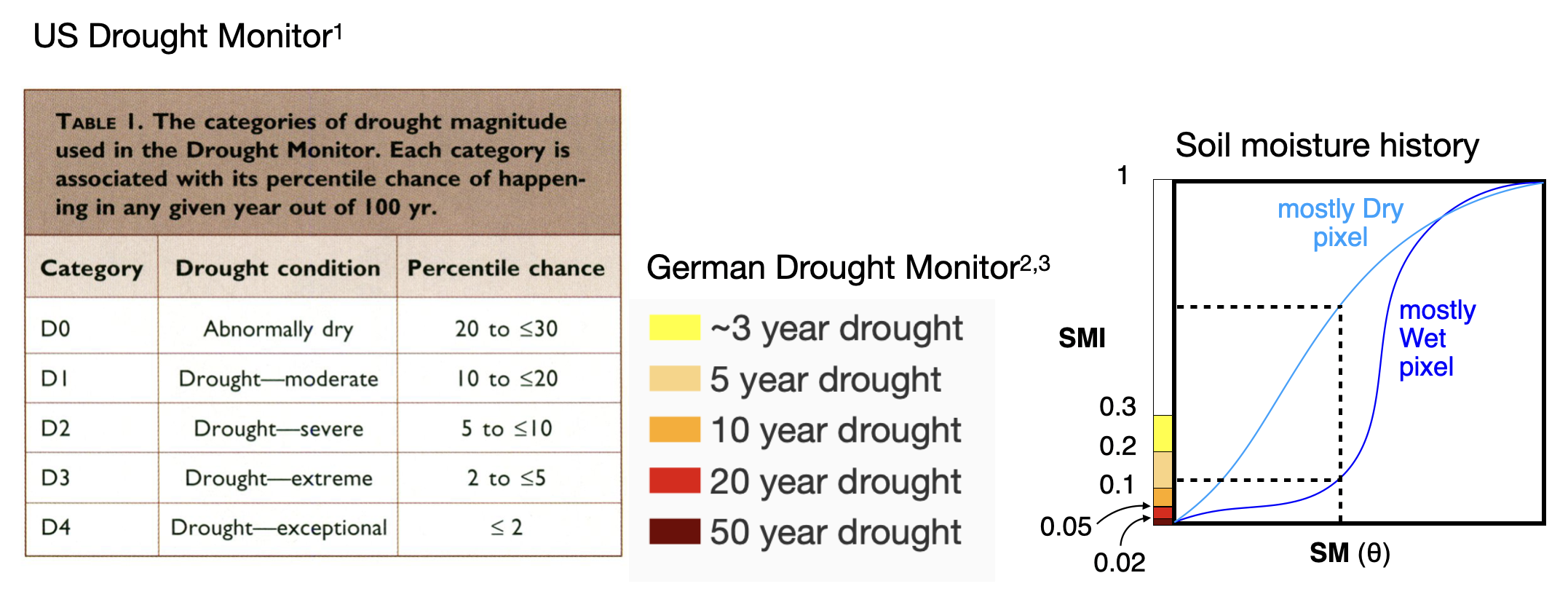
The NDM is a joint research initiative between the Institute of Engineering (IOE), Tribhuvan University, Kathmandu, Nepal, and the Helmholtz Centre for Environmental Research (UFZ), Leipzig, Germany. This partnership combines UFZ's expertise in large-scale distributed hydrological modelling and operational drought monitoring with IOE's deep knowledge of Nepal's hydro-climatic system, local data networks, and regional context.
The NDM team welcomes collaboration from interested institutions, government agencies, and research groups working on drought, water resources, and climate adaptation in Nepal and the broader Hindu Kush Himalaya region, to further enhance the system, expand its reach, and support its eventual operationalisation.
Disclaimer
The NDM is currently under active research and remains in a prototype phase. The present version of the system is intended for scientific evaluation, stakeholder engagement, and collaborative development, and is undergoing continuous testing. The results should therefore be interpreted with appropriate caution.
Call for collaborations
Collaborating institutions

_20231003165213_transparent.png "IOE logo")
Contact persons


Group leaders


Nepal Drought Monitor (NDM)

Operationalization Status of NDM
The NDM is currently in testing phase. The pilot model chain is implemented with on going addition of subsequent complexities. Please find the updated status below:
Incorporated tasks
version 0.0.1
01.05.2026
- The first operational version with 8 hours latency.
- Model chain operationalized in ecFlow workflow manager
- Runtime: ~ 10 minutes
- ERA5 land (10 km) pre and txxx download from the CDS with 7 days latency
- ERA5 land regridded to 12 km using conservative remapping
- IMERG Early (10 km) precipitation retrieved, extending pre to NRT
- IMERG Early regridded to 12 km using conservative remapping
- Daily temperature climatology used for extending txxx to NRT.
- mHM run at 1 km using the 1km ERA5 land (-6 day) + IMERG Early & Txxx climatology (-5 day to -1 day)
- SMI for total soil column
- SMI reference period: 1960-1999
- SMI graphics upload to UFZ files server
- Live link between this webpage and the UFZ files server
- Notification email (daily) on the success/failure of the suite
Pending tasks:
- Multiple soil layer based SMI
- Implementation of EDK in the suite
- Implementation of Bias correction of both ERA5 land and EO-based forcings using Gridded Observation Station Data (N-obs), at 1 km