
PhD Cohort SEESAW
Societal and Environmental impacts of complex ExtremeS in a chAnging World
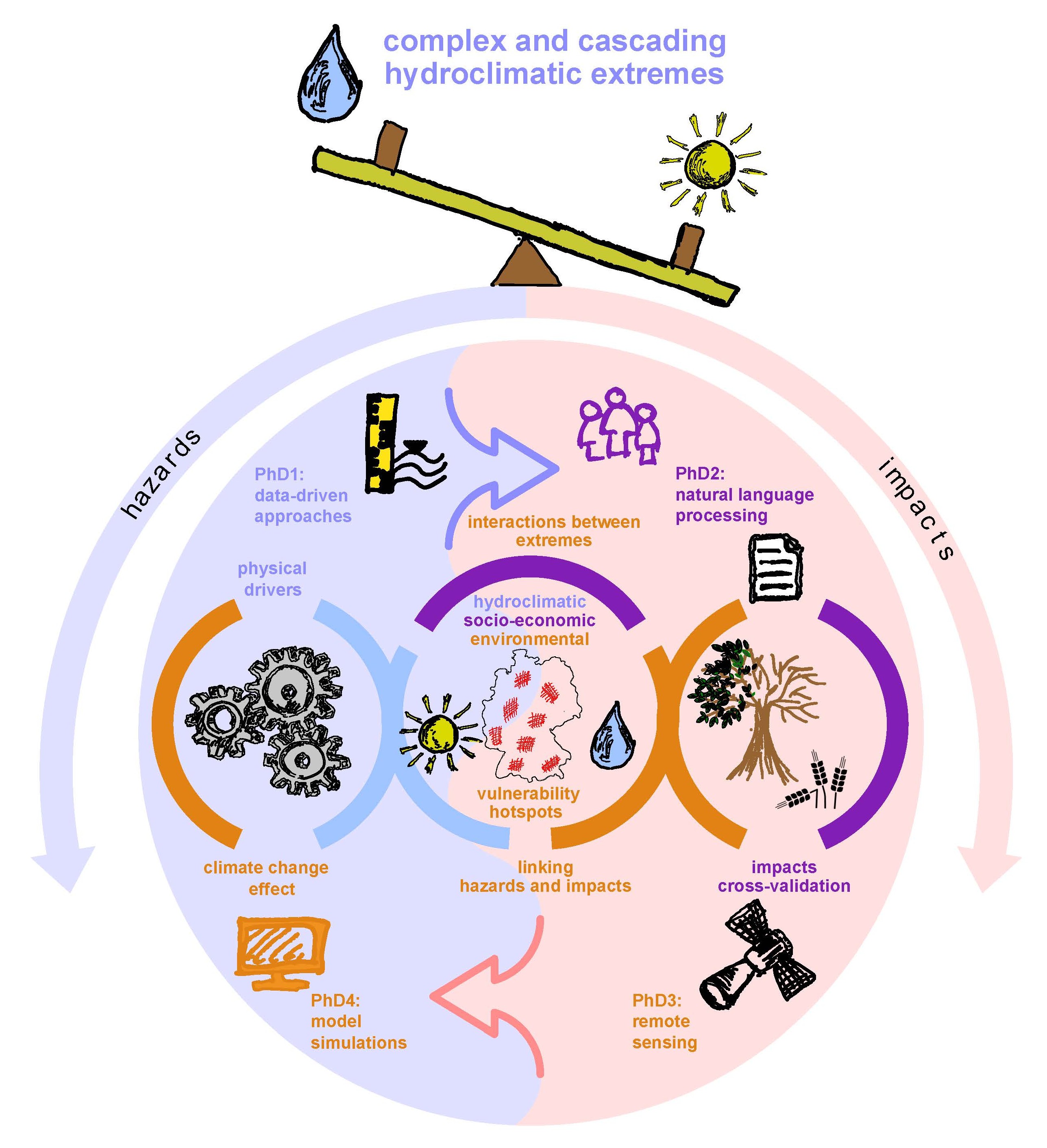
The SEESAW PhD cohort aims to understand the non-linear relation between complex hydroclimatic hazards, their socioeconomic and environmental impacts, as well as the climate change effect on such impactful events. For this purpose, we will use long-term hydrometeorological observations and process-based statistics, unprecedented newspaper dataset and large language models, AI-powered remote sensing and counterfactual climate model simulations. The activities of the cohort will help to identify vulnerability hotspots at national scale to support targeted adaptation measures.
SEESAW concept
- Considering complex extremes: collation, development and cross-validation of long-term multi-source monitoring products
- Linking hazards and impacts: understanding complex landscape and socio-economical feedback
- Disentangling climate change effect: novel counterfactual simulations of complex extremes
Coordinator
Principal Investigators
Larisa Tarasova, Mariana de Brito, Daniel Doktor, Emanuele Bevacqua
Subprojects
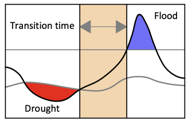
Objective: Identify river catchments characterized by long-lasting droughts, unexpected floods, and hence prone to extreme transitions by combining Germany-wide observations and novel process-based statistical approaches
PhD researcher
UFZ Advisors:
University advisor:
External advisor:
Objective: Unravel complex propagation of impacts across sectors using unique newspaper impact dataset and natural language processing

PhD researcher
UFZ advisors
University advisor
External advisor
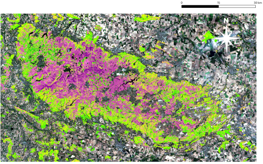
Objective: Relate long-term forest condition time series with respective groundwater levels by means of machine learning quantifying underlying climate change effects
PhD researcher
- Denis Streitmatter
UFZ advisors
University advisor
External advisor
Objective: Quantify human-induced climate change influence on high-impact drought-related compound events via novel climate and crop model simulations

PhD researcher
- Serkan Bayar
UFZ advisors
University advisor
External advisor