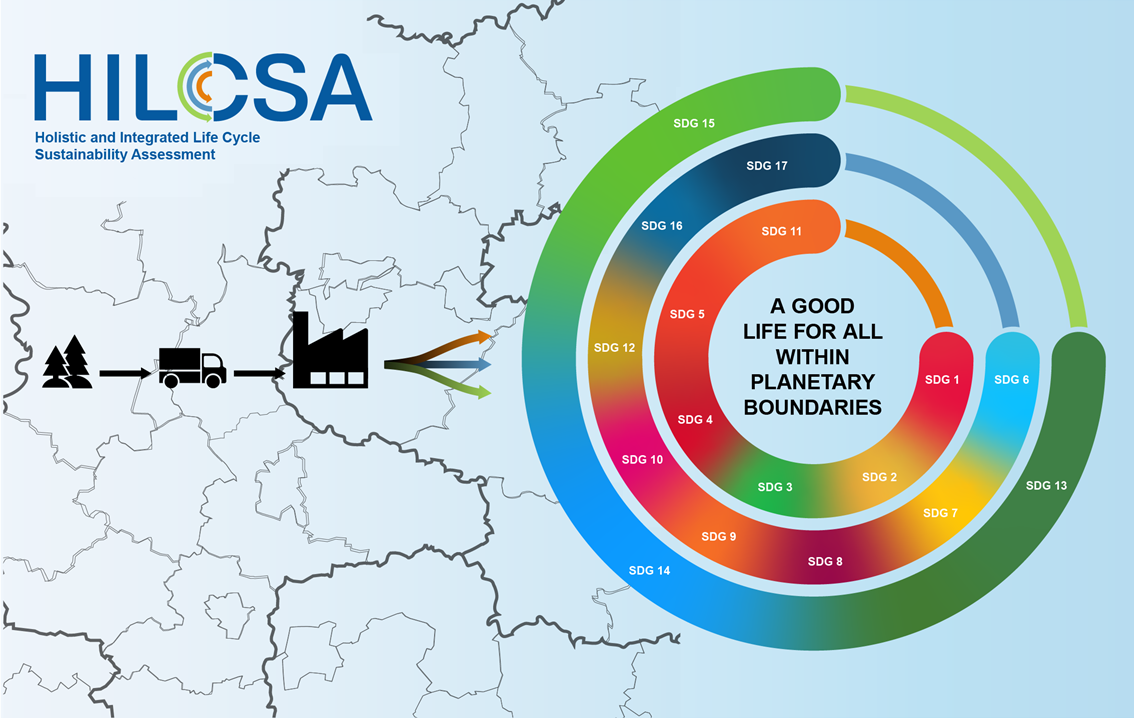
Holistic and Integrated Life Cycle Sustainability Assessment (HILCSA)
Contact persons: Dr.-Ing. Walther Zeug
Measuring and evaluating ecological, economic, and social sustainability across all stages of a product's, process’s, or service’s life cycle is at the core of established Life Cycle Assessment (LCA) methodologies. These approaches are increasingly combined into Life Cycle Sustainability Assessment (LCSA) frameworks. HILCSA—Holistic and Integrated Life Cycle Sustainability Assessment—is an innovative method within this field, enabling a comprehensive, ISO 14040/14044-compliant and integrated evaluation of holistic sustainability.
A Societal Perspective on Sustainability
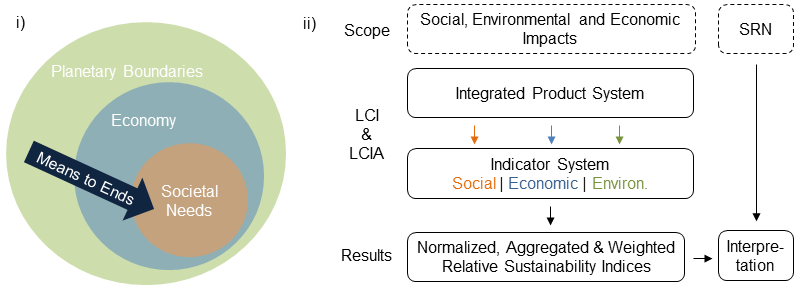
HILCSA builds on the Theory of Societal Relations to Nature, which views economic systems as comprising both physical and social components. These systems of societal metabolisms mediate the transformation of natural resources into goods and services for societal needs through infrastructures and economic practices. Based on this understanding, HILCSA defines sustainability as:- Social sustainability: Long-term, global fulfillment of societal needs and well-being
- Ecological sustainability: Long-term environmental stability as the foundation for societal reproduction, within planetary and regional ecological boundaries (PB)
- Economic sustainability: Efficient, effective, sufficient, and just technological and economic systems that support sustainable needs fulfillment within PB
A Holistic and Integrative Method
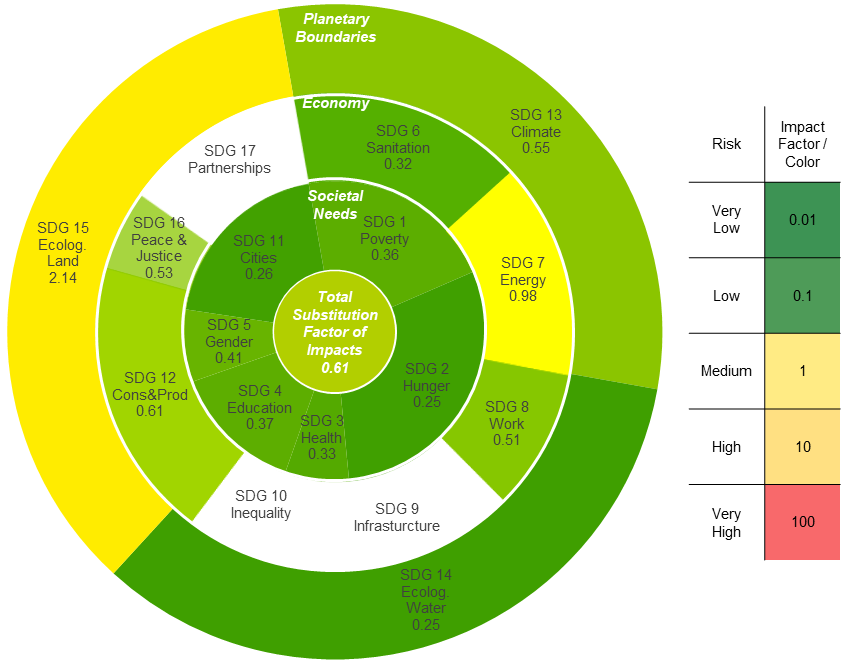
HILCSA integrates ecological, economic, and social dimensions into a single assessment framework. HILCSA models processes, products, organizations, and regions as integrated systems, incorporating material and energy flows, as well as working time. It uses up to 100 qualitative and quantitative indicators, aggregated into indices, across all three sustainability dimensions and addresses 14 of the 17 UN Sustainable Development Goals (SDGs). The method provides a transdisciplinary and critical analysis of sustainability trade-offs, synergies, and hotspots in production and consumption systems—particularly within the bioeconomy but also beyond. It is fully implemented in free the openLCA software, using data from the Ecoinvent and SoCa databases.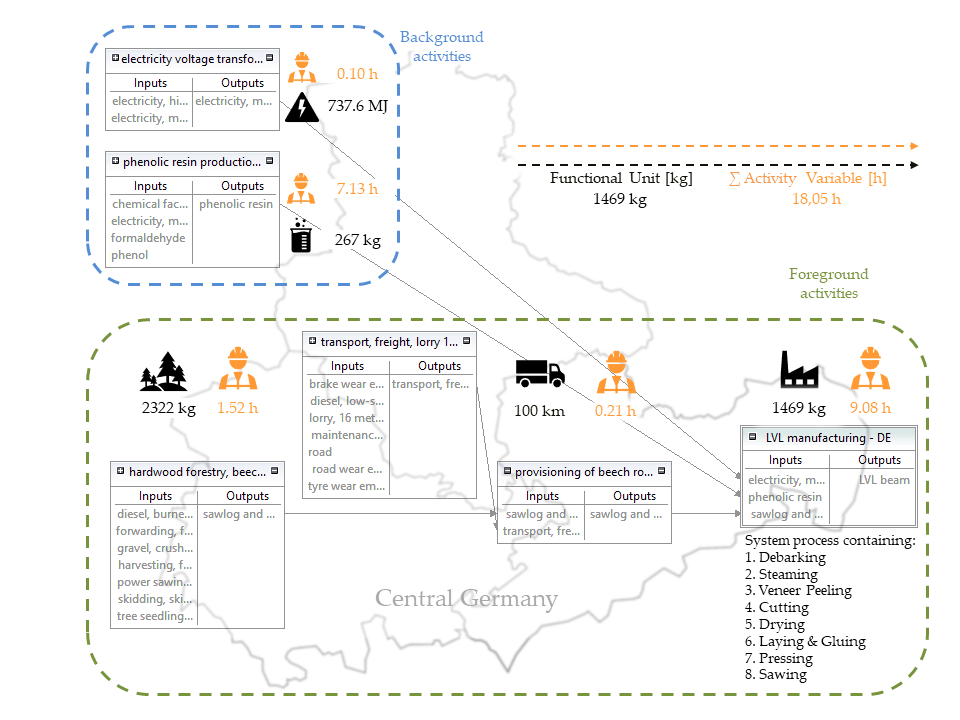
Case Studies and Applications
To date, HILCSA has been applied in several case studies, mostly in context of the bioeconomy. The method enables relative sustainability assessments, comparing innovative production systems to fossil-based systems or alternative resource use pathways. However, the method is not limited to that and suitable for comparisons across all economic sectors. Results—both qualitative and quantitative—are embedded in a broader transdisciplinary analysis of political economy and political ecology, incorporating stakeholder participation.
Key findings from two case studies demonstrate:- Sustainability effects are closely interlinked, creating complex synergies and trade-offs
- Without structural changes, relying on biomass imports can perpetuate global inequalities and externalities
- Material use of biomass in the construction sector often outperforms non-renewables and energetic use of biomass in terms of most SDGs
- The use of biomass can involve complex sustainability risks: while reducing greenhouse gases, it can lead to ecological, social, and economic drawbacks if not carefully managed
Decision Support for Policy, Civil Society, Research and Industry
By identifying detailed and aggregated synergies, trade-offs, and critical hotspots, HILCSA reveals common systemic risks and chances in economic systems and value chains, such as the bioeconomy with planetary limits on land and water availability and persistent socio-economic inequalities in global supply chains. It offers valuable, science-based decision support for policy, civil society, research and industry and connects sustainability assessment with normative societal and political questions.Licensing and use of HILCSA
The HILCSA method is publicly available and can be licensed for use in openLCA. It is provided via the Nexus platform of Green Delta GmbH.Method Update HILCSAv2.3
With the release of HILCSA on the Nexus platform for openLCA, a consolidated and user-friendly version 2.3 was developed. This version includes comprehensive documentation and a detailed manual for applying the method.Publications:
Backgrounds of the method:
General framework:
Case studies:
Projects:
KEK Monitoring − Status monitoring of the climate and energy concept of the state of Saxony-Anhalt