Press Release, 09. December 2025
Chemist Dusan Materic receives the UFZ Research Award 2025
New analytical method enables quantitative detection of nanoplastic particles
Chemist Dr. Dusan Materic has been awarded this year's UFZ Research Award, which is endowed with 10,000 euros. The UFZ researcher has developed an analytical method that can be used to detect nanoplastic particles in environmental and biological samples. The jury also praised his numerous interdisciplinary and international collaborations, which have made it possible to record nanoplastic exposure even in remote regions of the world.
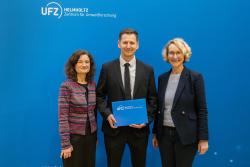
From left to right: Dr Sabine König (Administrative Director, UFZ), Dr Dusan Materic, Prof. Katrin Böhning-Gaese (Scientific Director, UFZ)
Photo: Klaus-Dieter Sonntag / UFZ
Dusan Materic's research focuses on nanoplastics, i.e., plastic particles smaller than 1 micrometer that are distributed worldwide due to their low weight. While the effects of macro- and microplastics on environmental pollution are already considered to be fairly well researched, much less is known about the even smaller nanoplastic particles and their impact on the environment, biodiversity, humans, and the climate. It is therefore important to quantitatively assess the level of nanoplastics pollution in the real environment and in humans, how they spread globally, and where their sources might be.
Dusan Materic developed an analysis method for this purpose based on a high-resolution proton transfer reaction mass spectrometer (PTR-MS). The PTR-MS is coupled with thermal desorption (TD) and can thus measure the concentrations of organic trace gases in environmental and biological samples. The TD-PTR-MS can be used to burn the tiny plastic particles in the samples. Heating releases gases that can then be quantified in the mass spectrometer. Since each polymer produces its own chemical fingerprint of gases, this measuring device can be used to determine the identity and concentration of plastics – even in the smallest sizes – with great accuracy.
The idea for this started to form during his PhD within EU-funded Marie Sklodowska-Curie Initial Training Network. During his postdoctoral studies at Utrecht University, he succeeded in proving the effectiveness of this method in cooperation with partners from industry and other research disciplines such as physics and materials science. This enabled him to prove for the first time the quantitative occurrence of nanoplastics in ice cores, for example in Greenland and Alps. At the UFZ, where he has been conducting research since 2022, Dusan Materic has taken the analysis to the next level: He refined the method and expanded it using strict quality control procedures and models from climate research, for example, in order to make statements about the aerodynamic dispersion of nanoplastics.
Dusan Materic has used the new methodology in research projects with international partners around the globe, whether at a depth of more than 4,500 meters in the North Atlantic, at an altitude of more than 3,000 meters in alpine glaciers, at the North and South Poles. In the process, he discovered, for example, that the tiny plastic particles can be found in all depth zones between the temperate and subtropical zones of the North Atlantic and that the amount of nanoplastics is comparable in mass to what has been found in microplastics to date. He was also able to detect a wide variety of sizes of nano- and microplastics in mussels grown for human consumption in Adriatic Sea. He is currently extending the use of his analytical method to humans and investigating how nanoplastics can be detected in various parts of the body and organs, such as the tonsils, pancreas, brain, and adipose tissue.
In addition to the Research Award, six other awards were presented to UFZ employees in 2025:
- Hydrobiologist Prof Dietrich Borchardt received the “UFZ Communication Award” for his excellent, long-standing, fact-based, and comprehensible communication on the topics of quantity, quality and management of water resources.
- Bioanalyst Dr Georg Braun is honored with the "UFZ Doctoral Award" for his excellent doctoral thesis, in which he developed an effect-based (human) biomonitoring of chemicals for the assessment of health-relevant mixture effects.
- Environmental process engineer Dr Ing Robert Köhler is honored for his “Outstanding Commitment” to creating a positive, cooperative, and effective working environment.
- The "UFZ Administration Award" goes to a team of colleagues from various administrative departments who jointly managed the complex construction process of the new research building – Kerstin Sachse, Jürgen Berndt, Ingo Teichmann, Jana Crone, Sandra Dietze (Building & Facility Management), Christian Zwanzig (Purchasing), and Sissy Deseife (Finance & Controlling).
- Plant biogeochemist Assoc. Prof Eva Marie Muehe and environmental chemist Dr Martin Krauss share the “UFZ Supervision Award” for their outstanding commitment to mentoring young scientists at the UFZ.
- Sustainability researcher Dr Johannes Förster receives the “Knowledge Transfer Award.” The award recognizes his activities in establishing sustainability reporting in companies.
The UFZ has been honouring outstanding achievements of its employees with the UFZ Awards every year since 2014.
Further information
UFZ press office
Susanne Hufe
Phone: +49 341 6025-1630
presse@ufz.de
In the Helmholtz Centre for Environmental Research (UFZ), scientists conduct research into the causes and consequences of far-reaching environmental changes. Their areas of study cover water resources, ecosystems of the future, environmental technologies and biotechnologies, the effects of chemicals in the environment, modelling and social-scientific issues. The UFZ employs more than 1,100 staff at its sites in Leipzig, Halle and Magdeburg. It is funded by the Federal Government, Saxony and Saxony-Anhalt.
www.ufz.deThe Helmholtz Association contributes to solving major challenges facing society, science and the economy with top scientific achievements in six research fields: Energy; Earth and Environment; Health; Key Technologies; Matter; and Aeronautics, Space and Transport. With some 39,000 employees in 19 research centres, the Helmholtz Association is Germany’s largest scientific organisation.
www.helmholtz.de