
Press Release, 09. November 2026
UFZ researcher receives Helmholtz Doctoral Award
Dr Pallav Kumar Shrestha honored for research on flood early warning
At Helmholtz, more than 8,000 doctoral candidates conduct research. Eleven of them have now been honored for their excellent doctoral theses. One of the award winners is hydrosystems modeller Dr Pallav Kumar Shrestha from the Helmholtz Centre for Environmental Research (UFZ). He developed methods that make global hydrological models more usable for local streamflow calculations. His research thereby creates important foundations for improved flood forecasting.
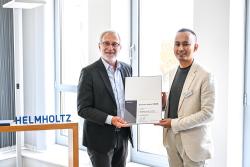
The Helmholtz President Prof Dr Martin Keller and Dr Pallav Kumar Shrestha from UFZ
Photo: Helmholtz / Oliver Walterscheid
Flooding repeatedly causes major damage not only in the catchments of large rivers, but also in smaller river catchments – as the Ahr Valley flood disaster of 2021 showed. At these small watercourses in particular, however, it is particularly difficult to forecast flooding, as these models used to date do not have a high enough resolution. This is where the dissertation of UFZ researcher Pallav Kumar Shrestha comes in. It contributes to the next generation of global flood early-warning systems by bridging a long-standing gap between large-scale hydrological modelling and local flood impacts and flood management.
For his doctoral work he used mHM, the hydrological model system developed at the UFZ, which can be used to calculate hydrologically important variables such as evaporation, soil moisture, and surface and groundwater runoff on various scales (local, regional, global). Building on this, the UFZ researcher developed a method for the scalability of streamflow simulations, meaning streamflow dynamics in river reaches, including human-managed reaches, can be estimated reliably and with high spatial accuracy worldwide and consistently across various model resolutions. A central component is the “Subgrid Catchment Conservation” (SCC) procedure he developed. It calculates river flow very precisely at the local level independent of the size of the river catchments – without needing to refine the entire model grid. This allows global models to be used for local flood forecasting and inundation modeling.
Dr Pallav Shrestha completed his studies at Tribhuvan University in Kathmandu (Nepal), where he obtained his Master’s degree in Water Resources Engineering in 2013. After three years of practical and programming experience in water engineering and management at the Asian Institute of Technology (AIT) in Thailand, he joined the Stochastic and Land Surface Hydrology Group at UFZ in 2017. Between 2022 and 2025, he completed his PhD at the University of Potsdam while working at UFZ, graduating with the distinction ‘magna cum laude’. Since last year, Pallav Shrestha continues his research in the field of hydrological modelling as a postdoctoral researcher at the UFZ. As part of Prof. Luis Samaniego’s group, he is working on the technical development of the UFZ Drought Monitor at European level (European Drought Monitor). In addition, in collaboration with stakeholders in his home country of Nepal, he is working on the implementation of the latest version of the mHM model – a pilot project for the general use of the model system in heavily mountainous regions with poor data infrastructure.
Helmholtz Website: https://www.helmholtz.de/en/newsroom/article/helmholtz-doctoral-prize-for-outstanding-research-achievements/
Further information
UFZ press office
Susanne Hufe
Phone: +49 341 6025-1630
presse@ufz.de
In the Helmholtz Centre for Environmental Research (UFZ), scientists conduct research into the causes and consequences of far-reaching environmental changes. Their areas of study cover water resources, ecosystems of the future, environmental technologies and biotechnologies, the effects of chemicals in the environment, modelling and social-scientific issues. The UFZ employs more than 1,100 staff at its sites in Leipzig, Halle and Magdeburg. It is funded by the Federal Government, Saxony and Saxony-Anhalt.
www.ufz.deThe Helmholtz Association contributes to solving major challenges facing society, science and the economy with top scientific achievements in six research fields: Energy; Earth and Environment; Health; Key Technologies; Matter; and Aeronautics, Space and Transport. With some 39,000 employees in 19 research centres, the Helmholtz Association is Germany’s largest scientific organisation.
www.helmholtz.de