Press Release, 18. March 2026
Water security for people and the environment
Helmholtz Initiative officially launched with three Solution Labs
Drought and heat stress as well as flooding and heavy rainfall resulting from a significantly changing water cycle have serious consequences for people, the economy, and nature. This was clearly demonstrated by extreme events such as the catastrophic flooding in the Ahr Valley in 2021 and the drought period from 2018 to 2021 in Central Europe. But how can we respond most effectively to contemporary and predicted future increases in such extreme events? And how can we increase our resilience to long-term changes in the water cycle? The Helmholtz Association is addressing these challenges through its research initiative Water Safety and Security for People and the Environment and is establishing three Solution Labs in which key aspects are addressed and potential solutions tested in close coordination with stakeholders and decision-makers across local, regional and national governance levels. The initiative is coordinated by the Helmholtz Centre for Environmental Research (UFZ).
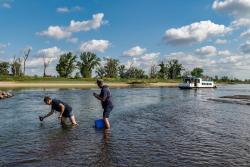
Taking water samples from the Elbe
Photo: André Künzelmann / UFZ
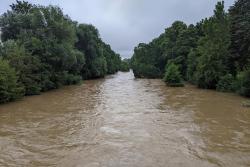
The 2021 Rur floods
Photo: Christian Poppe / FZJ
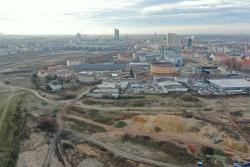
Site of the planned new development, Leipzig 416
Photo: InOneMedia
The initiative draws on a research profile that is unique in Germany. Through their areas of specialisation, the nine Helmholtz Centres involved cover the entire water cycle – from global and terrestrial systems to the molecular level. Over the next three years, in close collaboration with stakeholders from the water sector, urban development, industry, agriculture, nature conservation, and the public, they will develop intelligent management concepts, purification technologies, and early warning systems for use worldwide. “Water touches almost every aspect of our lives – from our health and reliable essential services to the question of how and where we will live in the future. Research in this area means taking responsibility for the future: for stable ecosystems, a resilient economy, and a liveable society. In order to address this complex issue in a holistic way, we at Helmholtz bring together interdisciplinary expertise, comprehensive data, and innovative technologies”, says Prof. Dr Martin Keller, President of the Helmholtz Association.
A central element of the initiative is the establishment of three Solution Labs. Three regions were selected for this purpose: the catchment areas of the rivers Elbe and Rur–Erft and the city of Leipzig; the challenges experienced there are typical of many other regions in Germany as well as across Europe and the world. They serve as real-world laboratories and pilot sites where key aspects are researched and potential solutions tested – all in close consultation with decision-makers from politics, private sectors, and civil society. “We want to demonstrate how relevant research findings can be put into practice more successfully than before”, says hydrobiologist Prof. Dr Dietrich Borchardt, coordinator and spokesperson for the research initiative at the UFZ.
SOLVE Solution Lab – new guiding principles for a near-natural water regime in the Elbe catchment area
The focus is on integrating extensive data and models from the entire Elbe river basin in order to develop solutions that holistically represent the entire landscape water cycle, including human interventions, and optimise water management across the catchment area. The reason for this is the high level of complexity involved in water management along the River Elbe. Over the past few decades, thousands of individual measures – ranging from river restoration projects to engineering interventions – have been implemented, and the corresponding action programmes continue to be updated. However, the cumulative effect of these many individual measures and how these interact within the water cycle of the river basin remain largely unknown.
At the same time, the river system is facing new challenges. The consequences of intensive mining in past decades, the establishment of major industrial sites – such as Tesla, Infineon, and other chip factories – in Silicon Saxony, and the high water demand in the Berlin metropolitan area are all large-scale interventions that are increasingly altering the water regime. Water availability is also becoming an increasingly important factor in regional economic development. The Elbe catchment area is also particularly suitable for analysis because it combines very different landscapes – from relatively dry regions around Berlin to high-rainfall areas in the Czech Republic and the Elbe estuary – and clearly reflects the different forms of water management that existed before German reunification. “The Elbe is a unique laboratory for understanding large-scale water processes”, says Prof. Dr Ralf Merz of the UFZ, spokesperson for the Solution Lab. “With SOLVE, we aim for the first time to systematically investigate how thousands of measures interact across an entire river system and, through a co-design process with our partners from public administration and practice, to derive optimised measures for sustainable water management across the entire catchment area”, he continues.
The SOLVE Solution Lab (Securing Terrestrial Water Cycles: the Helmholtz SOlution Lab Elbe RiVEr Basin) is coordinated by the UFZ. In addition to the UFZ, 16 other partners from the research and business sectors as well as government departments and agencies, including six other Helmholtz Centres, are involved.
Rur–Erft Solution Lab – Development of a digital twin to better understand complex interactions
The focus is on developing a digital twin of the Rur and Erft river catchments that combines numerical hydrological models with AI-based modelling. The aim is to make the impacts of climate change, land use, and human interventions on regional water resources visible, improve understanding of these factors, and derive concrete approaches to resolving water conflicts.
The region in North Rhine-Westphalia is under increasing pressure. Droughts and heavy rainfall events are becoming more frequent while agriculture, industry, and ecosystems all depend on the same water resources. Added to this are long-term changes in the water regime caused by opencast mining or large-scale drainage systems, the effects of which are still only partially understood.
One of the particular strengths of the region is the dense network of modern environmental monitoring stations, including the research networks TERENO, ICOS, and eLTER. They provide a unique data foundation for developing, validating, and further improving modelling tools.
Local stakeholders are involved in the research process from the outset. First, storylines are developed to define problem scenarios and possible measures for integration into the digital twin. In an interactive solution space, scientists can work together with water associations, municipalities, and farmers to virtually test various measures and analyse their potential consequences.
“We are moving away from traditional consultancy and one-way knowledge transfer. With our Solution Lab, we are creating a collaborative platform where stakeholders can interact directly with complex models and heterogeneous datasets. Our digital twins make Big Data tangible. Users can explore alternative pathways and the uncertainties associated with them in a transparent and participatory manner. Through this approach, we translate modern scientific methods and data into concrete, context-specific nature-based and technical measures. In this way, we help ensure the sustainable management of the terrestrial water cycle in the Rur and Erft catchment areas”, says Prof. Dr Stefan Kollet of Forschungszentrum Jülich (FZJ), spokesperson for the Rur–Erft Solution Lab, which
is coordinated by FZJ. In addition to the FZJ, 14 other partners from the research and business sectors as well as government departments and agencies, including three other Helmholtz Centres, are involved.
URBAN LE Solution Lab – Leipzig as a model city for integrated blue-green-red urban development
Using Leipzig as a model city, the URBAN LE Solution Lab is exploring how cities can address heavy rainfall, heat, and drought as part of climate adaptation. A research and development network with the aim of systematically integrating water security (blue), climate adaptation (green), and heat provision (red) within the context of urban transformation is being established here.
In selected representative urban neighbourhoods, including the Mitteldeutscher Rundfunk (MDR) site, the Leipzig Science Park, and several new residential developments, blue-green-red solutions are being developed and tested under real-life conditions and transferred into long-term operation. The focus is on measures that retain stormwater, relieve pressure on the sewer system, and provide cooling during periods of extreme heat. Functional digital twins represent complex baseline situations and enable different scenarios and effects to be compared transparently.
To accelerate the uptake of innovations in planning and implementation, research is integrated into municipal planning and decision-making structures from the outset. “We want to capitalise on the momentum of the heat transition in Leipzig to incorporate blue-green-red urban development right from the start”, says Prof. Dr Roland A. Müller from the UFZ, spokesperson for the Solution Lab. When roads, infrastructure systems, and neighbourhoods are being redesigned anyway, water-, energy-, and climate-resilient elements should be integrated into the planning process.
Several other cities have already expressed interest in participating. The aim is to not only implement solutions locally but also make them systematically scalable. Leipzig will thus become a real-world laboratory and model city from which evidence-based tools, governance frameworks, and technical solutions for climate- and water-resilient urban development will be provided both nationally and internationally.
The URBAN-LE Solution Lab (Systemic Blue-Green-Red Urban Development) is coordinated by the UFZ. In addition to the UFZ, 13 other partners from the research and business sectors as well as government departments and agencies, including three other Helmholtz Centres, are involved.
Alongside “Helmholtz Biomedical Engineering” and “Quantum Use Challenge”, “Water Security for People and the Environment” is one of the research initiatives through which the Helmholtz Association is addressing strategic future challenges in order to accelerate the practical application of technological breakthroughs. In total, the Helmholtz Association is providing EUR 36 million for these initiatives until the end of 2028.
Further information:
Interview with Prof. Dietrich Borchardt on World Water Day, 22 March: “Water has a democratic dimension”
Further information
Prof Dr Dietrich Borchardt
Senior Researcher at the UFZ and spokesperson for the Helmholtz Water Initiative
dietrich.borchardt@ufz.de
Prof Dr Ralf Merz
Head of the UFZ Department of Catchment Hydrology and spokesperson for the SOLVE Solution Lab
ralf.merz@ufz.de
Prof Dr Stefan Kollet
Head of the “Integrated Modelling of Terrestrial Systems” research group at FZJ and spokesperson for the Rur–Erft Solution Lab
s.kollet@fz-juelich.de
Prof Dr Roland A. Müller
Head of the UFZ Department of Systemic Environmental Biotechnology and spokesperson for the URBAN-LE Solution Lab
roland.mueller@ufz.de
UFZ press office
Susanne Hufe
Phone: +49 341 6025-1630
presse@ufz.de
In the Helmholtz Centre for Environmental Research (UFZ), scientists conduct research into the causes and consequences of far-reaching environmental changes. Their areas of study cover water resources, ecosystems of the future, environmental technologies and biotechnologies, the effects of chemicals in the environment, modelling and social-scientific issues. The UFZ employs more than 1,100 staff at its sites in Leipzig, Halle and Magdeburg. It is funded by the Federal Government, Saxony and Saxony-Anhalt.
www.ufz.deThe Helmholtz Association contributes to solving major challenges facing society, science and the economy with top scientific achievements in six research fields: Energy; Earth and Environment; Health; Key Technologies; Matter; and Aeronautics, Space and Transport. With some 39,000 employees in 19 research centres, the Helmholtz Association is Germany’s largest scientific organisation.
www.helmholtz.de