Press Release, 03. March 2026
BODIUM4Farmers: a decision-making tool for agriculture
Soil model enables the prediction of yields and soil health under different climate scenarios and land use systems
Agriculture is faced with many challenges. Climate change, new requirements under the Common Agricultural Policy (CAP), and rising expectations for environmental and resource protection are coinciding with the imperative to remain economically viable and ensure food security. Against this backdrop, scientists at the Helmholtz Centre for Environmental Research (UFZ) have developed the BODIUM4Farmers model tool based on the BODIUM soil model and have now made it available for use. The practical tool is aimed at helping farmers reconcile long-term land use, healthy soils, and stable yields.
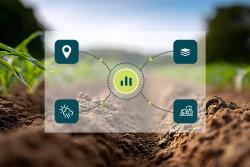
BODIUM4Farmers is designed for farmers and can help them assess the potential impact of changes in land use or climate on their fields.
Photo: pkproject_KI-generiert_AdobeStock / Grafik UFZ
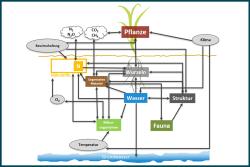
Scheme of the BODIUM model depicting components (coloured boxes), processes and interactions (arrows) and external factors (grey circles) within each soil.
Photo: UFZ
The soil is an important part of the ecosystem and fulfils many functions. For example, it produces biomass, stores and filters water, binds carbon, and provides a habitat for soil organisms. “Soils are complex systems in which a multitude of physical, chemical, and biological processes take place at different spatial levels”, says Dr Ute Wollschläger, soil researcher at the UFZ. However, because soils respond only slowly to changing conditions, scientific experiments can provide only limited insight into how they develop in response to land use and climate change. Soil models can provide universal answers and look further into the future. As part of the research project “BonaRes Centre for Soil Research”, UFZ researchers developed a soil model known as BODIUM. This model is based on proven models that simulate plant growth and water and solute flows in soils. The researchers have supplemented these models with new findings. This makes it possible to simulate plant and root growth, the movement of water, oxygen, and nitrate, and the turnover of organic material. “Our model differs from other soil models in its holistic approach”, says Dr Sara König, UFZ soil researcher and head of the BODIUM team. For example, BODIUM takes into account the temporal dynamics of the pore structure. This is formed by soil management and the biological activity of soil organisms and is crucial for water balance, carbon balance, and root growth. Furthermore, BODIUM is mechanistic in design. “This means that the soil model does not have to be recalibrated for each location”, says König. This makes it possible to predict medium- to long-term changes in soil functions depending on climate and land use under local site conditions and soil properties.
BODIUM4 Farmers – the practical tool
The BODIUM model forms the basis for the BODIUM4Farmers model tool, a tool designed to help farmers assess the potential effects of changes in land use or climate on their fields and make informed decisions to manage their land productively. In doing so, they can maintain healthy soil that fulfils as many soil functions as possible over the long term. On the interactive user interface, the field of interest is selected on a map and then linked to local weather data from the German Weather Service and an existing soil map. The soil data provided can then be checked and the cultivation data from previous years can be entered. In the next step, they can test various land use options. For example, they can experiment with other crops or catch crops in their rotation and vary fertilisation and soil management, all against the backdrop of different precipitation and climate scenarios.
BODIUM4Farmers then provides information on the development of yields, carbon storage, water storage capacity, nutrient losses and nutrient use efficiency (e.g. nitrogen retention capacity) for the desired area. For each indicator, the differences between current land use and the selected scenario can be displayed as percentage changes or as annual absolute values. “The tool also provides farmers with important soil-related knowledge that many of them did not learn in such detail during their training”, says Wollschläger. Of course, BODIUM4Farmers also has its limitations. “For example, the tool cannot precisely predict the exact organic carbon content of a given area in 30 years’ time. However, it shows the direction in which it changes under varying land use practices and weather conditions”, says Wollschläger. It also makes little sense to calculate scenarios only for the following year. “Such a projection is too dependent on weather conditions. We recommend requesting scenarios for at least two crop rotations in order to identify trends”, adds König.
The online tool is freely available. The data entered are protected by login and are available only to the farmers who provide them. BODIUM4Farmers was developed in workshops with farmers. It is currently being used by initial agricultural enterprises and further refined through close collaboration. The tool is intended for use by agricultural enterprises across Europe.
BODIUM4Farmers web tool: https://bodium4farmers.de/
Publication on the systemic soil model BODIUM, the basis of BODIUM4Farmers:
König S., Weller U., Betancur?Corredor B., Lang B., Reitz T., Wiesmeier M., Wollschläger U., Vogel H. (2023). BODIUM – A systemic approach to model the dynamics of soil functions. European Journal of Soil Science, 74(5), https://doi.org/10.1111/ejss.13411
BODIUM-Website: https://www.bonares.de/service-portal/models-concepts-evaluations/bodium-modell
Further information
Dr Sara König
UFZ Department Soil System Science
sara.koenig@ufz.de
Dr Ute Wollschläger
UFZ Department Soil System Science
ute.wollschlaeger@ufz.de
UFZ press office
Susanne Hufe
Phone: +49 341 6025-1630
presse@ufz.de
In the Helmholtz Centre for Environmental Research (UFZ), scientists conduct research into the causes and consequences of far-reaching environmental changes. Their areas of study cover water resources, ecosystems of the future, environmental technologies and biotechnologies, the effects of chemicals in the environment, modelling and social-scientific issues. The UFZ employs more than 1,100 staff at its sites in Leipzig, Halle and Magdeburg. It is funded by the Federal Government, Saxony and Saxony-Anhalt.
www.ufz.deThe Helmholtz Association contributes to solving major challenges facing society, science and the economy with top scientific achievements in six research fields: Energy; Earth and Environment; Health; Key Technologies; Matter; and Aeronautics, Space and Transport. With some 39,000 employees in 19 research centres, the Helmholtz Association is Germany’s largest scientific organisation.
www.helmholtz.de