
Press Release, 13. January 2026
Not only toxic but also a nutrient: guanidine as a nitrogen source
A riboswitch as an important tool in sustainable biotechnology
Guanidine is an organic compound primarily used as a denaturing reagent to disrupt the structures of proteins and nucleic acids. Together with partner institutions, scientists at the Helmholtz Centre for Environmental Research (UFZ) have demonstrated that cyanobacteria, which play a central role in global biogeochemical cycles, use guanidine as a nitrogen source. The results were recently published in the Proceedings of the National Academy of Sciences (PNAS). The researchers shed light on the underlying mechanisms and the potential for a new tool for sustainable biotechnological applications.
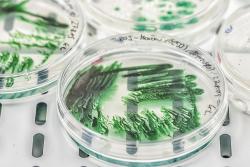
Cyanobacteria convert light energy into chemical energy through photosynthesis and are becoming increasingly important for carbon-neutral biotechnology.
Photo: André Künzelmann / UFZ
Cyanobacteria are key ecological players of global carbon and nitrogen cycles. They are also becoming increasingly important for carbon-neutral biotechnology. They could serve as green cell factories for a light-driven and sustainable production of chemicals and fuels – a central pillar of the sustainable bioeconomy.
However, compared with other bacteria such as Escherichia coli, little is known about how cyanobacteria respond to environmental and internal signals, how their metabolism is coordinated, and how these regulatory mechanisms function.
The study, published by the UFZ in collaboration with Heinrich Heine University Düsseldorf and Martin Luther University Halle-Wittenberg, shows that cyanobacteria can actively absorb and break down guanidine (CH5N3) and even use it as their sole nitrogen source. This suggests that free guanidine is available in natural habitats and that the ability to use it is an advantage for colonisation – even though guanidine has previously been regarded primarily as a toxic substance.
It was already known that guanidine is broken down in the cyanobacterial cell by guanidine hydrolase into ammonium and urea, which enter the metabolism through further reactions. The newly researched aspects include the uptake of guanidine as a nutrient via a newly discovered ATP-binding cassette (ABC) transport system, which recognises guanidine with high affinity and ensures import into the cell even at low environmental guanidine concentrations. At the same time, a special transport system (efflux system) that can also transport guanidine out of the cells protects them from excessive and therefore harmful concentrations. The enzymes and transport systems responsible for guanidine metabolism are widespread in cyanobacteria.
"The study shows that guanidine is an integral part of nitrogen metabolism and must therefore also play a role in global biogeochemical cycles in nature", says Dr Stephan Klähn, molecular microbiologist at the UFZ and coordinator of the study. To achieve this, the researchers combined genome analyses, molecular microbiology methods and biochemical binding studies with simulation-based process analyses and additionally investigated the regulation of guanidine metabolism. Genes for guanidine transporters and hydrolases are regulated at several levels, including via a riboswitch that reacts directly to guanidine binding. Researchers are harnessing this mechanism for biotechnology: The riboswitch serves as a precisely controllable element that can be used to finely adjust gene expression in cyanobacteria by adding guanidine. This yields a molecular tool for the cost-effective control of biotechnological production processes suitable for a wide range of applications in synthetic biology.
Publication:
M. Amadeus Itzenhäuser, Andreas M. Enkerlin, Jan A. Dewald, Bihter Av?ar, Ron Stauder, Hannes Halpick, Rosalie Schaale, Lisa M. Baumann, Noelia Fernandez Merayo, Thomas Maskow, Khaled A. Selim, Christina E. Weinberg, and Stephan Klähn: Deciphering guanidine assimilation and riboswitch-based gene regulation in cyanobacteria for synthetic biology applications, PNAS, https://doi.org/10.1073/pnas.2519335122
Further information
Dr Stephan Klähn
UFZ Department of Solar Materials Biotechnology
stephan.klaehn@ufz.de
UFZ press office
Susanne Hufe
Phone: +49 341 6025-1630
presse@ufz.de
In the Helmholtz Centre for Environmental Research (UFZ), scientists conduct research into the causes and consequences of far-reaching environmental changes. Their areas of study cover water resources, ecosystems of the future, environmental technologies and biotechnologies, the effects of chemicals in the environment, modelling and social-scientific issues. The UFZ employs more than 1,100 staff at its sites in Leipzig, Halle and Magdeburg. It is funded by the Federal Government, Saxony and Saxony-Anhalt.
www.ufz.deThe Helmholtz Association contributes to solving major challenges facing society, science and the economy with top scientific achievements in six research fields: Energy; Earth and Environment; Health; Key Technologies; Matter; and Aeronautics, Space and Transport. With some 39,000 employees in 19 research centres, the Helmholtz Association is Germany’s largest scientific organisation.
www.helmholtz.de