Press Release, 08. January 2026
Bringing nature, society and the economy together
Scientists call for a new concept of sustainable development
What does the term sustainable development actually mean? Until now, the sustainability framework has been based on a three-pillar model that separates nature, society and the economy. However, against the backdrop of accelerated climate change, loss of biodiversity and inequalities between people, this is no longer appropriate. A group of renowned researchers, including Prof Dr Josef Settele from the Helmholtz Centre for Environmental Research (UFZ), who have been involved in the Intergovernmental Science-Policy Platform on Biodiversity and Ecosystem Services (IPBES) for many years, are now calling for a fundamental reorientation of the way humanity understands and pursues sustainable development. The article appeared in Nature Communications Sustainability.
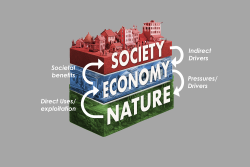
The new systems model of nature, economy and society and feedback loops between them.
Photo: CORDIO East Africa
In their article, the authors propose a new model of sustainable development that, bottom-up, positions nature as the foundation, supporting economies as the next level, which deliver benefits to the third level, society. From a top-down perspective, societal values and governance systems determine how people organize their economies, and therefore how these affects nature, on which they are dependent. "We need to move beyond the idea that nature, economy, and society are separate domains," said first author Dr David Obura, Director of CORDIO East Africa, and also currently the Chair of the IPBES. “Our model sees them as inter-connected layers of one integrated system. With it, any company, community or country can track the flow of benefits from nature through economic sectors to people, and the ways in which our choices impact on nature.”
Model change: From separated pillars to integrated levels
Since its introduction by the Brundtland Report ‘Our Common Future’ by the World Commission on Environment and Development in 1987, the concept of sustainable development has guided global efforts to balance human well-being, economic growth and environmental protection. Yet, after nearly four decades, evidence shows that the separation of nature, economy and society has produced fragmented, competing priorities that often deepen the very crises sustainability aims to solve.
In their new model, the authors integrate decades of research and practice to describe sustainable development as a single, dynamic system. The model posits that three types of capital – natural, economic and social – underpin sustainability and are linked through feedbacks that determine whether societies thrive or decline. When one type of capital is over-developed or depleted, the system destabilises. Our systems model argues that when all types of capital are maintained in balance, resilience and long-term well-being and security become possible.
The model reveals that today’s sustainability challenges are not just market failures, as often described, but result from deeper ‘values failures’. That is, the failure to account for the values and choices made across all three domains. Narrow economic worldviews, rooted in extraction, privatization and short-term profit, have sidelined other essential values such as care, reciprocity, and respect for nature and other people. "Sustainable development requires more than addressing market failures; it necessitates recognizing and integrating the diverse values held by different societal groups, ensuring that all voices are considered in shaping our collective future", said Prof Mike Christie, Aberystwyth University and co-chair of the IPBES Values Assessment.
What Needs to Change
By clarifying the relationships between nature, economy and society, the model provides both a conceptual and a pragmatic upgrade to the current framing of sustainable development and its Sustainable Development Goals (SDGs), supporting discussions for a post-2030 global sustainability agenda (Sustainability/SDGs 2.0?) framed around systems balance and diverse values. "Already in the first Global Assessment of IPBES in 2019 one of the consensus key messages was that a key component of sustainable pathways is the evolution of global financial and economic systems to build a global sustainable economy, steering away from the current, limited paradigm of economic growth", said Prof Josef Settele from UFZ and Co-Chair of the first Global Assessment of IPBES.
The paper calls for reorienting development - not only from the perspectives of governments, but also for businesses and the whole of society, towards balance between nature, economy, and society. Achieving this transformation requires moving beyond fragmented, growth-driven approaches that focus solely on economic outcomes, towards strategies that safeguard the integrity of all three capitals – natural, social and economic. "Sustainability cannot be achieved by treating nature, economy and society as separate silos. A systems approach reveals them as parts of a single, interdependent whole — one in which balance, not growth alone, is the foundation of a thriving future", said Prof Paula Harrison, UK Centre for Ecology & Hydrology and co-chair of the IPBES Nexus Assessment.
To achieve this, the authors recommend four key shifts:
- Reframe sustainability around systems balance – recognizing that all human activity is dependent on ecological stability.
- Embed plural values –bringing Indigenous, cultural and relational worldviews into mainstream sustainability policy and measurement.
- Adopt systems-based governance –designing policies that recognize inter-dependencies and account for feedbacks between social, economic and ecological processes.
- Redefine progress –moving beyond GDP growth to measures that reflect the health of each of the capitals, and flows between them, including ecological health, equity and long-term human well-being.
Publication:
Obura, D.O.; Agrawal, A.; Christie, M.; Fromentin, J.-M.; Harrison, P.A.; Jones, M.; O’Brien, K.; Pauchard, A.; Roy, H.E.; Settele, J.; Stoett, P. (2025). "A Systems Reset for Sustainable Development", Nature Communications Sustainability, https://doi.org/10.1038/s44458-025-00009-3
Further information
Prof Dr Josef Settele
Head of the UFZ Department of Conservation Biology & Social-Ecological Systems / German Advisory Council on the Environment
josef.settele@ufz.de
Dr David Obura
Director, CORDIO East Africa / IPBES Chair
dobura@cordioea.net
UFZ press office
Susanne Hufe
Phone: +49 341 6025-1630
presse@ufz.de
In the Helmholtz Centre for Environmental Research (UFZ), scientists conduct research into the causes and consequences of far-reaching environmental changes. Their areas of study cover water resources, ecosystems of the future, environmental technologies and biotechnologies, the effects of chemicals in the environment, modelling and social-scientific issues. The UFZ employs more than 1,100 staff at its sites in Leipzig, Halle and Magdeburg. It is funded by the Federal Government, Saxony and Saxony-Anhalt.
www.ufz.deThe Helmholtz Association contributes to solving major challenges facing society, science and the economy with top scientific achievements in six research fields: Energy; Earth and Environment; Health; Key Technologies; Matter; and Aeronautics, Space and Transport. With some 39,000 employees in 19 research centres, the Helmholtz Association is Germany’s largest scientific organisation.
www.helmholtz.de